Tag Archives: editing

Quitting gets a little easier every time.

I used to smoke regularly. It started when I was 13 with a Marlboro red 100 (if you’re going to do it, go big). My friend D and I sat at the top of a long set of stairs leading down to a narrow path that cut through my small Neckarsteinach neighborhood, and she pulled one from the soft pack. “Are you sure you want one?” she said.

“Yeah. Just give it to me.”

I was an automatic inhaler. I didn’t even know how to puff. I’d take a drag, and then I’d blow out the smoke, cough, and spit.

“Are you inhaling?” she said.

I said I didn’t know.

“Try just puffing,” she said.

I pulled on the filter and the smoke crawled down my throat. I shrugged, blew out the smoke, coughed, and spit. She laughed.

I switched to lights and smoked off and on until 9th grade, when I started for real. (Cigarette in the morning before school, “nic fits” before I could run outside with friends to have one during the long break between second and third period, cigarette or two after a chili-fries and egg roll lunch, etc.)

I tried quitting at 18, and I was almost successful. My boyfriend at the time and I  both wanted to quit, so we stopped bringing our cigarettes with us in the car, and I remember I even had a successful night downtown – not one cigarette. (“Downtown” means “at the bar” – Germany, 16 legal age.)

I don’t remember when or why I started up again, but I did.

I tried to quit again at 26 by cutting down to no more than four cigarettes a day. It was working very well – I’d just gone down to three a day – and then, on the morning of September 11, I broke away from the TV after watching for two hours to rush to the gas station for a pack.

At 29 years old, I was still smoking. My hair had also gone through enough highlighting to have turned all of it very light blond, and I decided I did not want to be the 30-year-old cigarette smoking bleach blond. Before my birthday, I dyed my hair back to its natural color and started to quit smoking again by cutting down. (Cold turkey doesn’t work for me – it’s too rigid.)

Something similar is happening with my efforts to quit marketing Homefront.

The addiction to marketing started out slowly enough – I made a MySpace page, designed a few fliers.

As I learned more about the many marketing avenues there were, I gradually and increasingly immersed myself in promotion for two years. (Minus the time spent working one of those years.) Making phone calls, sending emails, arranging readings and signings, and so on. And on and on and on.

Before Homefront, I’d been writing all kinds of things. Short stories, articles, essays, flash fiction. When I finished one project, I would send it out for rejections and start a new one.

For over a year, I’ve been trying to quit marketing Homefront so I can get back to writing new things. I tried once in late 2008 after starting Dan Palace my first week living in Connecticut. I figured I’d write while I looked for a job, and when a few weeks later I started working for the newspaper, I was successful, for the most part, at forgetting about Homefront. My days were too busy to worry about marketing. Every now and then I’d dip into it if something occurred to me that I hadn’t tried, yet, but the activity was very sporadic.

A year later, when I moved to Tennessee, I was going to take a year away from working to write. Not market, write.

It worked for a little while. Then I’d hear something on the news that applied to Homefront – something allowing me a lead-in for a press release – and the writing would be set aside for the marketing.

Several months ago, I was almost successful at letting go again. I finished writing Dan Palace and the editing was coming along. I was determined to let Homefront sit for good.

But then we got this news we were moving again, and I was too busy to have any real zone-time for editing/revising/rewriting Dan Palace, so I thought I may as well use random hours here and there to market Homefront

Thank goodness for wise people.

One of them told me yesterday that if I can’t let go of Homefront, I won’t be able to enjoy working on something new.

This person is absolutely right.

I’ve done all I can with it, and if I want to be a career writer, I have to be able to put my energy into the creative writing process. I have to be able to enjoy it the way I did when I was writing Homefront and everything that came before it.

Besides. The last thing I want to be is that person clinging desperately to the one thing she did years ago because it felt so good and so right. You can get away with being a bleached-blond smoker when you’re young, but the day comes when it just starts to look ridiculous and it’s time for a nicotine patch and a trip to the salon.

A book’s stages of growth – in pictures.

Everyone probably has their own way of going about writing a book, but I bet there’s a fairly common series of steps.

1. The Writing Journal

Practically essential (for those who are into writing journals, anyway) for initial ideas and ongoing notes. I can’t have enough of these things. The one you see to the left has about 1/3 of the pages unused, but once I finished using it for Pretty Much True…, I figured I’d need a new one for the next project. (Yes, need. And then I needed another one for the project I imagined I might someday work on years from now. What? Writers need journals like chefs need good knives!)

The unused pages don’t go to waste, though. They’re good for jotting notes to Ian or folding in half and turning into bookmarks.

2. The Writing in the Writing Journal

It’s not enough to carry it around – it should be used. You may not remember all of your notes…in fact, while taking pictures of this today I found some notes I had no idea about and was glad I didn’t follow…but there’s always sure to be something really, really valuable in there. Having it with you most of the time is a good idea for the person who has a lot of ideas while they’re doing other things. I used to think I’d remember my brilliant ideas because, well, how could anyone forget a brilliant idea? But invariably, ten minutes later, *poof.*

notes

Journals are also fun to have because, years after you’ve finished your book and you can’t imagine it any other way, you see all the other ideas you had. These pages seems to suggest not only a few bad titles, but also that I was going to have Jake come home for R&R at the end, and then have Mia’s behavior contradict her actual psychological state. I know why I planned to do that, but that’s not something to get into here. Moving on!

Once the book is “done” (that is, once the last page is written), it’s unbelievably helpful to print every page and read it through, beginning to end. I don’t know why, but there are things I caught on paper that I never would have caught looking at it on the screen. It’s just different. Period. (More on the kinds of things you notice a little further down.)

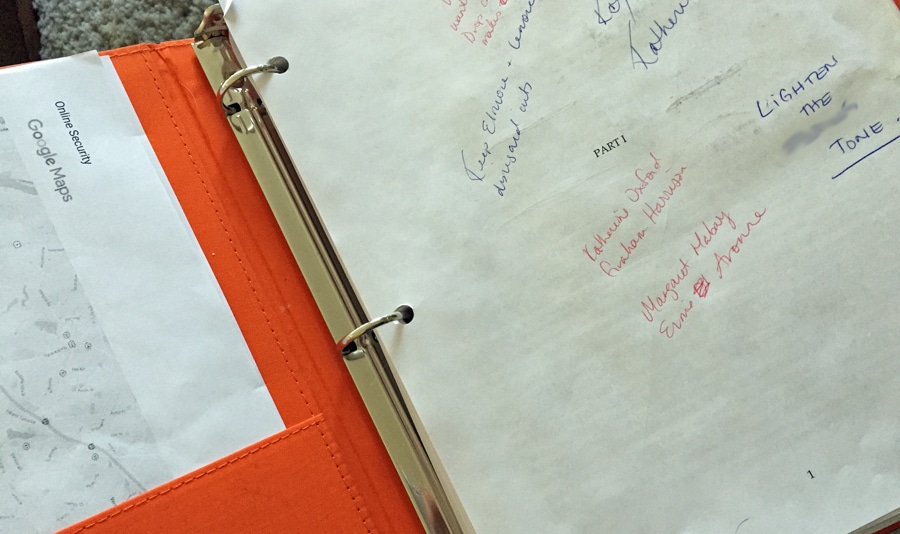
3. The Binder

I kept Pretty Much True… (seen here with its original title) in a binder, and with my rough, at-home-designed-and-printed-on-regular-paper cover on the front. I’d printed a couple versions of a cover while writing, and I kept each incarnation of the cover taped to a set of shelves next to my desk so I’d see it while I was writing. It helped to imagine it being finished. A real, complete book with a cover and everything.

(I really should do that for the one I’m writing now…)

The binder held (and still holds) all things Pretty Much True…- related.

Such as…

a. Notes by helpful readers, to whom I am forever indebted

importance of readers

 This person’s feedback was absolutely invaluable. I met him on an online writers site and he read

every

single

chapter

and commented on each one. Unbelievably generous. That he’s an exceptional writer, and also a former editor, was a bonus, too. He wasn’t the only one to offer feedback, and I have to say…I’m incredibly fortunate to know so many people who read critically and carefully. Ian, my husband, is one of the best critics to have given me advice about PMT. Never underestimate the value of early readers – without them, PMT would have been a completely different book.

b. The book

Exhibit A (of A) showing the “completely different book”: The original first page

original first page

This page is actually the first run at the second draft. The first draft was in third-person and had a character named Terri before, 80 single-spaced pages into it,  I started over from page one. I think I deleted the original 80 pages.

(I don’t recommend deleting 80 pages in most cases.)

Things you notice when the book changes form:

1. Word choice and unnecessary details

word choice 2

cut cut cut

2. All kinds of other things

confusing notes

Once the first paper draft has been carefully dissected and corrected, the whole thing is pretty much done.

(*Snort* Not really. At least, not in this case. Because, at some point, the 8.5 x 11 pages will turn into a book, which is a whole different form to be read. And what’s amazing about reading the book as a book is how many more things stand out.)

Things that stand out when reading a book that now looks like a book:

1. Unnecessary details & dialogue, and unnatural sounding dialogue

book page notes

2. The importance of having just the right insult

word choice

Once that version has been picked at a few times, it’s probably safe to say “done.”

Pictures make it look like nothing, and talking about it makes it sound like nothing. But it’s really such a process, and one that was too easy to forget. Writing Dan Palace, I keep thinking, “This should be easier. I should be able to get it all down, do it all right, the first time. Pretty Much True… was so simple. There was no second-guessing or stressing or mulling or hair-tearing. Why isn’t this one like that!?”

Clearly, I’ve forgotten a lot (everything?) about that experience.

Writing a book must be like childbirth (which I haven’t experienced): you forget the pain once it’s over. And then, like a crazy person, you want to do it again.

The other side-editing American Fiction

Beloved Weld Hall

Beloved Weld Hall

Once upon a time, I went to school at Minnesota State University Moorhead (MN). Actually, I spent seven years at that school. After receiving my BA at year four, I hyperventilated for about a month because What the hell am I going to do with a BA??

Ohhhh….I know–I’ll just stay in school. Get my MFA!

It wasn’t a difficult choice to make; I wanted to write, and staying in school for two, two and a half more years–most of which would be filled with writing workshops–was like being a kid and having someone tell me I’d “have” to spend my days in the cool fort out back with buckets of chocolate chip ice cream.

I don’t know how useful my degree has been–that is, I don’t know how directly responsible it’s been for anything I’ve been able to do–but it did prevent me from getting jobs in a few towns. Hotels didn’t want to hire me (they called me “overqualified”), and I couldn’t get a job at a bookstore (I maintain it’s because of the degree). However, I did get a job at a newspaper with no prior (actual) reporting experience, and my degree could have had something to do with that. I’ve never been certain, though. Turnover was high at the paper, and I applied at a lucky time, I think. (I should note that it was, and still is, a really good paper, despite the turnover. At mid-sized papers, reporters will eventually decide they want to move on to something bigger.)

Two things I know I can confidently attribute to my MFA, however:

1. Writing. I’d not have written the many stories I did, nor received the inspiration to write more, without the grad school writing workshops

2. Being editor of American Fiction

When I started taking writing classes at MSUM in 1997, American Fiction was one of the ahhh-AHHH!s of literary journals whose list of guest fiction contest judges include Joyce Carol Oates, Tim O’Brien, and Raymond Carver, and it was (and still is) published by MSUM’s own New Rivers Press.  (This year’s contest judge is two-time Pulitzer Prize nominee Clint McCown, whose bio can be found here.)

I had fantasies of being included in AF, of having one of my own stories among those of the real writers. They weren’t even fantasies, actually, because publishing in a journal like that with writers I knew were so far beyond me–talented and magical and other-worldly Writers who were undoubtedly always thinking profound and artistic thoughts, probably had unruly hair, and of course wore wrinkled, natural fibers–seemed such a distant goal for a beginning “serious” writer that I was more likely to think about it for a few seconds, think “Yeah, that’d be cool,” and then look at the clock and wait for class to end.

I took creative writing classes throughout college, many of them with instructor (and New Rivers senior editor, I later learned) Alan Davis, author of the short fiction collections Alone with the Owl and Rumors From the Lost World.

He attracted me as an instructor immediately because he didn’t talk like a Minnesotan. No offense to Midwesterners, but the accent has always driven me crazy. (If you’ve seen Fargo, whose Midwestern accents are highly exaggerated, you know every “o” sounds like “ouwh.” And bagel – pronounced, by most, “BAY-gull,” is, to a Minnesotan, “BAG-el.”) I even used to practice a sentence every now and then–”I want to know how to speak normally in Minnesota”–to make sure I held onto my accent-less speech cultivated in the melting-pot environment of an overseas military community.

I heard Davis’ accent in my intro to creative writing class and thought, “He’s from New England!” I loved all things New England; therefore, I immediately liked him.

He introduced himself and said he was from Louisiana.

Okay, so my accent-pinning skills were off, but he was still from “somewhere else,” which was really all that mattered.

Classes began with all the creative writing exercises writers know and love, and Davis’ critiques were concise. For example, “Slight” was the only comment he scrawled on one of my stories. My favorite one-word critiques from him? “Good.”

It’s largely due to Davis that I stuck with writing. His one-words challenged me, and I was encouraged by his praise. He was the one to recommend I keep writing, and then that I take a graduate-level workshop while in my senior year of undergrad, and ultimately that I apply to get my MFA. (Like many writers or other artistically-motivated people, I had little confidence in my own ability. I didn’t know enough to know whether what I wrote was any good–or, if I thought it was good, I didn’t know if I had the right to think it without someone else thinking it, too. Someone who knew what he was talking about.)

Since the age of 12, I’d always thought I wanted to write, but college let me know.

american fiction imageAfter a few years of writing classes, Davis suggested I submit something sometime to American Fiction.

There could not have been better praise. He made clear, of course, that submitting something didn’t mean having that something accepted, but his telling me I should submit alone felt a lot like being nominated for something wonderful. It was like being told I was, even just a little bit, good. And that I had a chance at being lumped in with all the patchouli-smelling, pontificating, hemp-wearing Real Writers.

Alas, by the time I felt I was ready to submit, American Fiction had gone on hiatus.

I submitted to other journals, instead, and went my merry way writing this and that. While writing Homefront, I decided I needed breaks, now and then, from my characters, and I founded and edited, with Shelly Rae Rich, Tuesday Shorts, an on-line journal publishing flash fiction. I wasn’t as interested in being an editor as I was in being a writer, but it was a fun project and it was gratifying to read so much good–if very short–writing, and to be responsible for a weekly collection of stories people wanted to read. (Tuesday Shorts, founded in April 2007, closed in May of this year.)

Last year, Davis approached me–along with co/assistant-editors Bayard Godsave and Bruce Pratt–about reviving American Fiction with us as editors. “Interested?” he said.

Uh…YES?

Okay, so I wouldn’t get to have one of my stories included (however tempting it might have been to submit something to one of the other editors using a pen name and taking my chances). But I would get to be part of American Fiction, this journal known for its superior writing and authors, whose place in the literary world has twice been recognized by Writers Digest as “one of the best places in the United States to publish fiction.”

Even more thrilling than just being part of it?

I get to send acceptance letters to contest finalists and know I might be delivering news to someone who, like me, could once only have imagined being one of the Real Writers whose stories made it into American Fiction.

Essential Writers interview, plus the edited-out bit.

(Cross-posted at Backword Books)

essential writersUK-based Essential Writers editor Judy Darley interviewed me recently about writing, Homefront, and – inadvertently – Backword Books. Have I mentioned that while I hate, hate, hate being in front of people and talking about anything remotely “me,” I looooove answering interview questions via email? And what an absolute honor to be sought out by Essential Writers.

Some of my responses were truncated (which means I actually end up sounding more professional and “writerly-writer” than I think I am), and one of the cutting-room answers involved my feelings after being nominated for a Pushcart Prize. Undoubtedly, it was cut for length, because I can be overly “blahblahblah, blah blah BLAH blah…and thennnn…”, but I’d like to include that part here, because it’s amazing how easily others can taint something that would otherwise be “I’m-getting-so-wasted-tonight!” exciting:

How did it feel to discover …you were nominated for a  Pushcart Prize?

Being nominated for a Pushcart Prize was exciting, too, but strangely less so [than winning the Storyglossia Fiction Prize]. I think because I was part of an online writers workshop, at the time, and there was a lot of talk about how anyone can nominate anyone for a Pushcart Prize. Your mother can nominate you. So, while I was truly very excited to have been nominated by an editor, and while I still – three years later – appreciate it and love to simply have the knowledge that my writing was nominated for such a coveted prize, the pooh-poohing of it by other writers squelched my enthusiasm, a little. Winning – now, that would have been something.

“It’s an honor just to be nominated,” they say. And truly, often it is. Really. But when you learn you can even nominate yourself and then claim to have been nominated, you have to wonder how many people are going to roll their eyes at your “Nominated for a Pushcart Prize” and think, “Everyone gets nominated for that.”

When I worked at the Journal Inquirer, I received a little index card in my mailbox that said I’d been nominated for some award in journalism. (I forget what it was.) I thought, “Wow! And I just started!” I then found out everyone in my newsroom, and in newsrooms across the country, were nominated for it. Editors nominate their reporters in a sort of raffle. All nominees are invited to attend a dinner or other journalist-y event where the winners will receive their awards. Most reporters can be pretty sure they’re not going to win (especially when, like me, they hadn’t had more than a six-month career in the field, hadn’t exposed anything particularly noteworthy, and hadn’t – frankly – earned it).

So, naturally, I went from being “Ohmygod!” excited to “Ohhh. Mmm-kay.” (Much like the day Oprah called me.)

That’s why I said what I said about winning the Pushcart. Because not everyone wins the Pushcart. Hell, hardly anyone wins the Pushcart.

I want one, fer sure.

The rest of the Essential Writers interview can be found here. Thanks, Judy, for the interview! I’m excited and honored to have been included.